
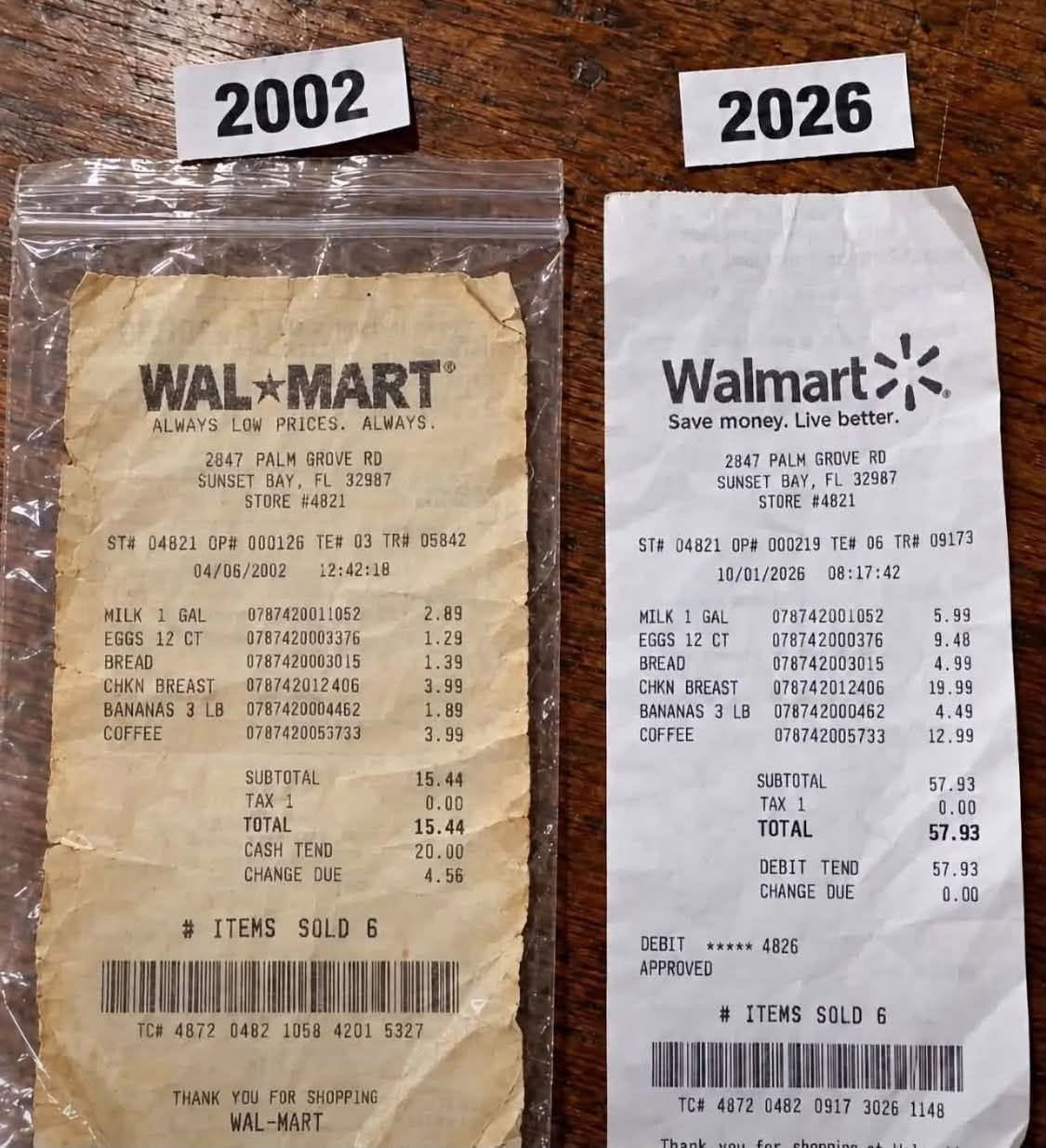
Two apparently ordinary shopping receipts deliver a dramatic message: the same basic groceries now cost almost four times as much.
The image pairs receipts labelled 2002 and 2026, listing milk, eggs, bread, chicken breast, bananas and coffee. Their displayed totals imply a rise of approximately 275%. But those figures should not be presented as documented Walmart transactions.
Why the comparison fails
Lead Stories examined this exact image and identified it as fabricated. Its investigation found that the supposed Florida store address, ZIP code and store number did not correspond to a real Walmart location. It also reported an AI-detection result supporting its conclusion, although automated detection alone cannot establish authenticity. The problems with the purported store details are the more concrete warning signs.
There is another weakness visible in the comparison itself. Several product descriptions omit package sizes or weights. “Chicken breast” and “coffee” are not sufficiently precise descriptions for a meaningful comparison across 24 years. A fair comparison requires equivalent quantities and products, as well as genuine records.
Household pressure is real
None of this makes household financial pressure imaginary. The U.S. Bureau of Labor Statistics reported that consumer prices were 3.7% higher in September 2026 than a year earlier. Its detailed figures show different foods moving in different directions: coffee prices were up 7.1% over the year, while egg prices were down 20.6%. Neither measure validates the prices printed on these supposed receipts.
Annual inflation also needs to be distinguished from the price level. A slower rate of increase does not mean earlier increases have disappeared. Families can remain under pressure even when inflation moderates, particularly when their income has failed to keep pace with essential expenses.
Affordability deserves serious scrutiny
Our view is that scrutiny should focus on what households can afford after paying for housing, utilities, transport and food. Policymakers should be judged against measurable changes in purchasing power, rather than reassuring slogans.
A fabricated receipt weakens that scrutiny. It gives critics an easily disproved example and distracts from questions that can be investigated using actual prices, comparable quantities and household incomes.
The affordability problem deserves serious reporting. It does not need an invented shopping bill.
Independent reporting. A European perspective.