
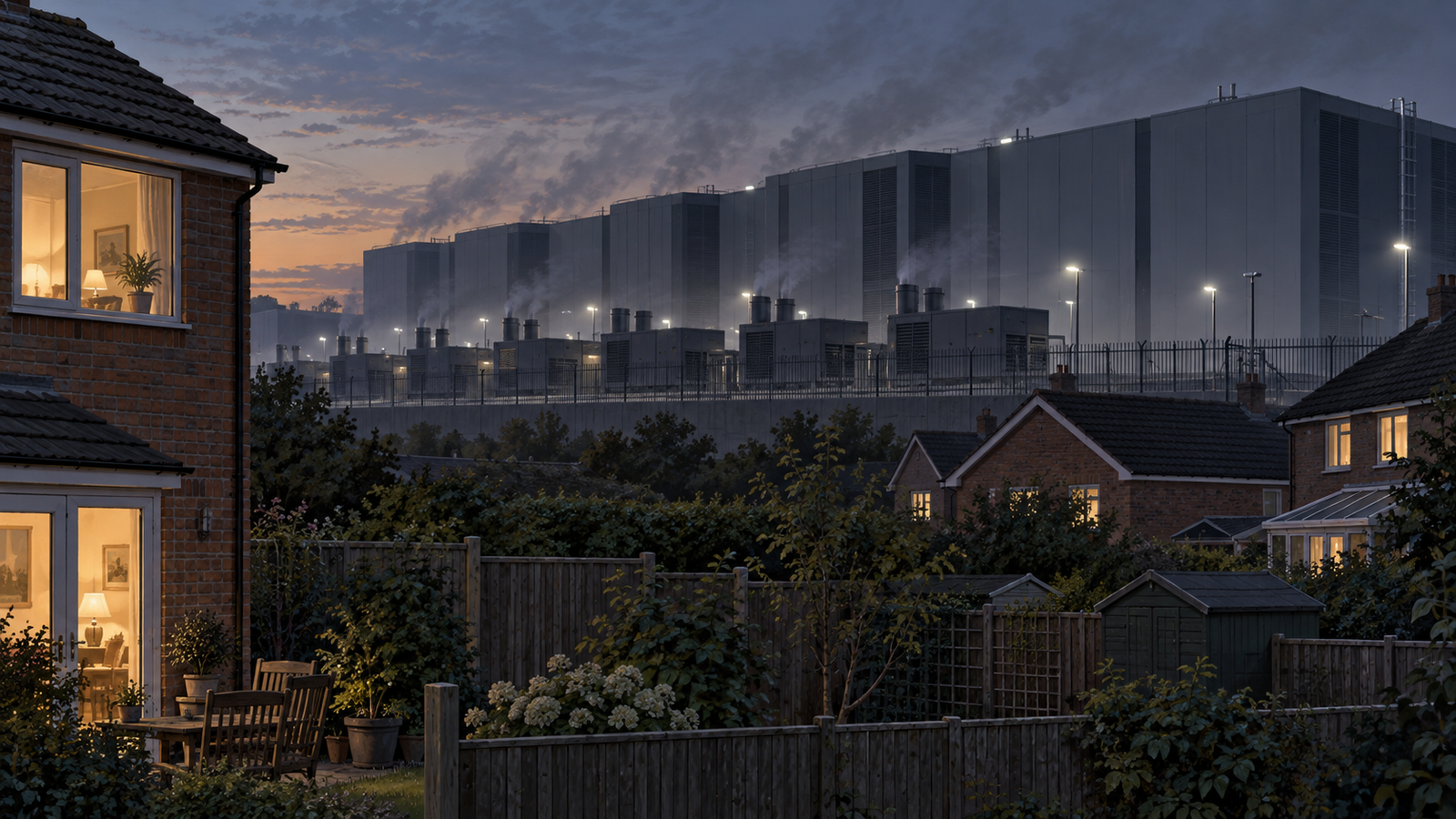
Greg Pirio’s account brings the data-centre debate down to a single household. After diesel generators started at the Vantage VA2 campus beside his Sterling neighbourhood, he told WUSA9 that his lungs hurt and that he went to his daughter’s home. The servers had backup power. He sought somewhere else to breathe.
WUSA9’s report, published on 20 July 2026, described almost a full day of diesel operation after a failure at the campus’s own power plant. The incident occurred amid wildfire-related air-quality alerts. Virginia’s environmental regulator said the existing rules did not give it authority to stop the emergency operation.
That account deserves attention without embellishment. It documents a resident leaving his home; it does not establish a compulsory evacuation of the neighbourhood. His reported symptoms are testimony, rather than a clinical finding about the precise source of an injury. The distinction makes the underlying question sharper: why should a household have to accommodate an industrial emergency on its doorstep?
A power plant beside the neighbourhood
VA2 illustrates a physical reality often hidden by talk of the cloud. This is industrial infrastructure, with power generation, exhaust, machinery and neighbouring homes.
The Piedmont Environmental Council describes the facility’s permitted onsite power system as eight natural-gas turbines and 51 backup diesel generators. Its commissioned study examines the potential consequences of that permitted system. The July incident followed a failure of the onsite power source, according to the published reporting. It was not simply a story of a normal office waiting for the public electricity supply to return.
This distinction matters to the planning argument. When a development depends on its own fossil-fuel generation, the surrounding community must be told about the power plant as clearly as it is told about the building. A data-centre label should never obscure what will actually operate on the land.
What the public record adds
Documents presented at an August town hall provide a direct account from the company and county. In its presentation, Vantage said emergency generators had been used twice in 2026 following critical power failures, for approximately 24 hours each time. It maintained that it met state and federal requirements and described sound-reduction work.
The county’s material records a 63.45 dB(A) reading on 17 July, associated with the outage and generator operation. It also sets out exemptions for emergency generator noise. A measurement above an ordinary residential threshold therefore cannot, on its own, be declared a proven violation. This is precisely why the exemptions deserve political scrutiny: lawful operation can still leave neighbours with conditions they find intolerable.
Vantage’s listed measures include acoustic treatments for turbine inlets, enclosure vents and other equipment. Those efforts should be judged by what residents experience and what independent measurements show. A presentation about mitigation is the beginning of accountability, not its completion.
The health dispute must be faced openly
There is a substantive disagreement about longer-term pollution. EmPower Analytics Group’s analysis, commissioned by the Piedmont Environmental Council, estimated that emissions at the facility’s permitted limits could produce $53 million to $99 million a year in health-related damages. The analysis models population exposure and associated effects; it is not a count of diagnosed illnesses from the July outage.
Virginia DEQ’s April assessment challenged the use of maximum permitted emissions and aspects of the modelling. The agency said the approach appeared to overstate actual emissions and that nearby air-quality monitoring supported a different picture.
Both positions belong in the public record. Residents should not be asked to choose between a frightening number and an official reassurance without access to the assumptions, measurements and operating data behind them. The useful next step is independent scrutiny of actual emissions, alongside a clear account of what happens during unusual operating conditions.
The uncertainty does not erase Pirio’s complaint. Nor does his complaint settle a regional epidemiological argument. It establishes why a neighbourhood needs evidence it can trust and a regulator able to respond to the conditions people are reporting.
Editorial view: a home must come before an expansion timetable
Our position is against the rush to build AI and other large data centres beside homes when the public protections have not caught up. Corporations should have to demonstrate that a proposed site can operate safely and acceptably before receiving permission to expand. Residents should not have to demonstrate, one exhausted household at a time, that the consequences are unbearable afterward.
Consider what the promise of uninterrupted service means on either side of the fence. For an operator, interruption threatens contracts and business. For a family, interruption can mean lost sleep, a closed window, a garden they no longer want to use or a night spent somewhere else. Those costs belong in the decision even when they do not appear on the company’s accounts.
An investor can choose another project. A household cannot casually replace its street, its school, its neighbours and the savings tied up in its home. Planning policy should recognise that imbalance. The people with the least room to move need the strongest protection at the point where permission is granted.
Emergency powers should protect the neighbours too
Backup generation has a legitimate purpose. A sudden shutdown can create technical and safety problems, and essential services require continuity. But a legitimate purpose does not justify an exemption with no meaningful protection for those living nearby.
We favour emergency rules that require prompt notification, accessible operating logs, independent monitoring during extended runs and a defined public-health response. Officials need to know how many engines are operating, for how long and under what conditions. Residents need someone responsible for answering the telephone and acting on credible complaints.
Where safe and technically feasible, an extended incident should trigger assessment of load reduction and alternatives. Any procedure must be planned in advance, with engineers and public authorities establishing how to reduce harm without creating another emergency. The operator should fund that preparation and any necessary monitoring.
Repeated failures should also prompt a review of the primary power arrangement. A backup system can protect equipment while revealing that the wider development is poorly suited to its setting. Approving more capacity before understanding that problem would put corporate growth ahead of the neighbourhood’s interests.
A community needs the power to say no
Consultation is meaningful only while a decision can still change. A meeting after construction, when machinery is already running, offers residents a far weaker position than a public hearing before approval.
The review should cover the complete development: the buildings, their power sources, backup equipment and the combined effects of nearby sites. Separate permissions should not prevent the community from seeing the whole proposal. Noise should be assessed where people live and sleep, including persistent tonal sound, rather than reduced to a reassuring average that leaves the experience unexplained.
We support a pause on new approvals in places where those protections are missing. A pause gives authorities time to establish enforceable standards and evaluate cumulative effects. If an operator cannot show that a site near housing is appropriate, the answer should be refusal or relocation.
Tax revenue deserves examination, but it cannot purchase an unlimited claim over the neighbourhood. The assessment must ask who receives the benefits and who bears the disturbance. A county-wide gain does not automatically compensate the household immediately beside the machinery.
The AI boom has to justify its demands
AI development is helping drive the wider demand for computing infrastructure. The available evidence here does not establish which workloads VA2 was processing during the outage. We should not invent a particular AI customer to strengthen the argument.
The wider policy question remains: why should an industry's demand for more computing capacity automatically outrank the community’s demand for clean air and quiet homes? Companies seeking land, electricity and permission should explain the public value of their proposal and accept the cost of protecting its neighbours.
There should be no assumption that every expansion is urgent merely because it is attached to the language of innovation. Elected officials are entitled to ask whether the location is suitable, whether the safeguards are credible and whether the promised benefits justify the burdens. They are also entitled to conclude that they do not.
What a policy for people would require
A policy that puts residents first would require full disclosure of onsite generation before approval, independent scrutiny of noise and emissions, meaningful public participation and an enforceable plan for prolonged backup operation. Protection should continue if the facility is sold; obligations should follow the site rather than depend on a particular management team’s goodwill.
Costs created by the project should remain with the project. Households should not be expected to finance monitoring, pay for specialist advice simply to understand a permit or absorb disruption as their contribution to corporate success. Public authorities should make the evidence accessible and provide a route to remedies that ordinary people can actually use.
Sterling’s lesson is uncomfortable but concrete. A facility can keep operating while a neighbour feels he must leave. Our test of progress begins with that neighbour. Until communities have reliable protection, a genuine voice and authorities with effective powers, the push for more AI data-centre capacity should wait.
Independent reporting. A European perspective.